|
In our classroom there
are many components of Reader's Workshop. These include shared
reading, read alouds, guided reading (as part of literacy centres)
and independent reading.
Our Classroom Library
Our library is extensive as I LOVE to buy books! When you purchase
from our book orders, it allows me to choose free books for our
library. At the beginning of the school year I interview the boys
and girls and find out what they love to read. I use this
information to help me choose the books for our library. I am always
on the lookout for new and fun reading material that is level, age
and grade-appropriate. We have a wide variety of text forms in our
library including: fiction (big books, picture books and chapter
books), non-fiction, poetry and magazines. |
|
 |
|
Shared Reading
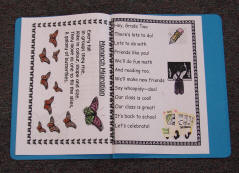
Shared reading is a chance for students to practice reading with
teacher support in a whole or small group. We often use poems for
shared reading and these are stored in our Shared Reading Duotangs.
We often send these home as part of Show and Share so that your
child can read them with you. The children have many favourites and
frequent reading of these help them to develop fluency and
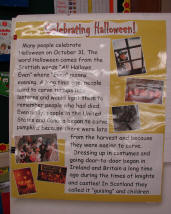
confidence. Shared reading is also very common during science and
social studies. I create information charts that teach the children
about the various topics we study. These are around the room for
frequent reference and re-reading. |
|
 |
 |
|
Read Alouds
A key component of the reader's workshop is the Read Aloud. This is
when I read aloud to the class, often modeling reading strategies. I
"think aloud" as I read to the students. I read a wide variety of
texts for read alouds including poetry, high quality picture books,
chapter books, magazine articles and non-fiction text. When we are
finished working with a read aloud text, the students practice the
reading strategy I have taught them. First they practice in a small
group or with a partner to help prepare them for trying it on their
own. Then the students are expected to begin using the strategy with
the books that they choose to read independently. |
|
|
|
Guided Reading
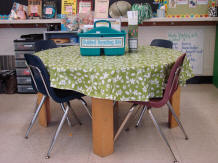
As part of our literacy centres, small groups of students meet with
me for guided reading. At this time, I am teaching a small group of
students who share a common need with their reading. It could be
that a group of students are having trouble using picture clues to
help them decode words so we work on this together. Each student is
given a text that is slightly above their reading level as they will
be receiving support while reading it. The whole group works and
reads with discussion and then applies the necessary skills. Again,
the goal is that the students use what they have learned
independently with the texts that they have chosen for independent
reading. |
|
 |
|
|
Independent Reading
This is the part of the reading program where students really show
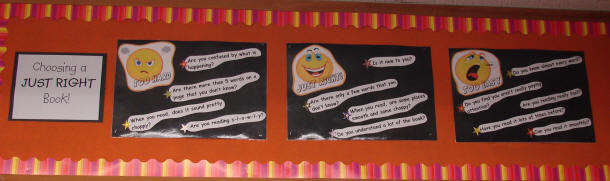
"what they know". Each student carefully chooses a book that is
"just right" for him or her at their reading level. |
|
 |
|
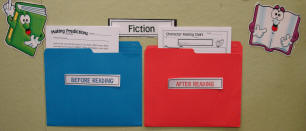
The student completes a "Before
Reading" activity for their book. These activities are prediction
activities. The student uses the cover, the title and/or the back of
the book to predict what they believe the book will be about or what
he or she will learn while reading the text. |
|
Next, the student works on reading
their book. While reading he or she is encouraged to think about
what is being read. Some students may track their thinking with
"think marks" (a bookmark that can be written on) for use later on. |
 |
|
After reading their book, the student
chooses an "After Reading" activity to complete for what they read.
There are many choices of activities. I model how to do these
activities on chart paper throughout the year and hang these up as
"anchor charts" for the students to refer to. These activities allow
students to share what they have understood (comprehension) and have
learned from their reading. They are a very important part of their
reading mark, as they show that students can independently apply
what they have been taught. |
|
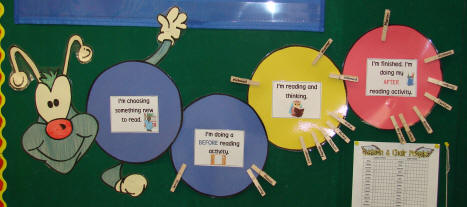
Throughout this process, the boys and
girls "track" their reading on our Bookworm. Each student has a clip
and moves it along the bookworm as they progress from choosing a
book, to completing a before activity, reading and completing an
after activity. |
|
 |
|
While all of the students are working
with their books, I am conferencing with individual students. At
this time each student reads aloud to me from their book and we chat
about their reading. I ask the students questions and we talk about
the strategies that they are using to read and understand. Finally,
we may look at their activities and I will give them feedback about
how they can improve. Conferences are short, about 5-10 minutes in
length, but they provide important information about the children as
readers. |
|
|
|
|
|
